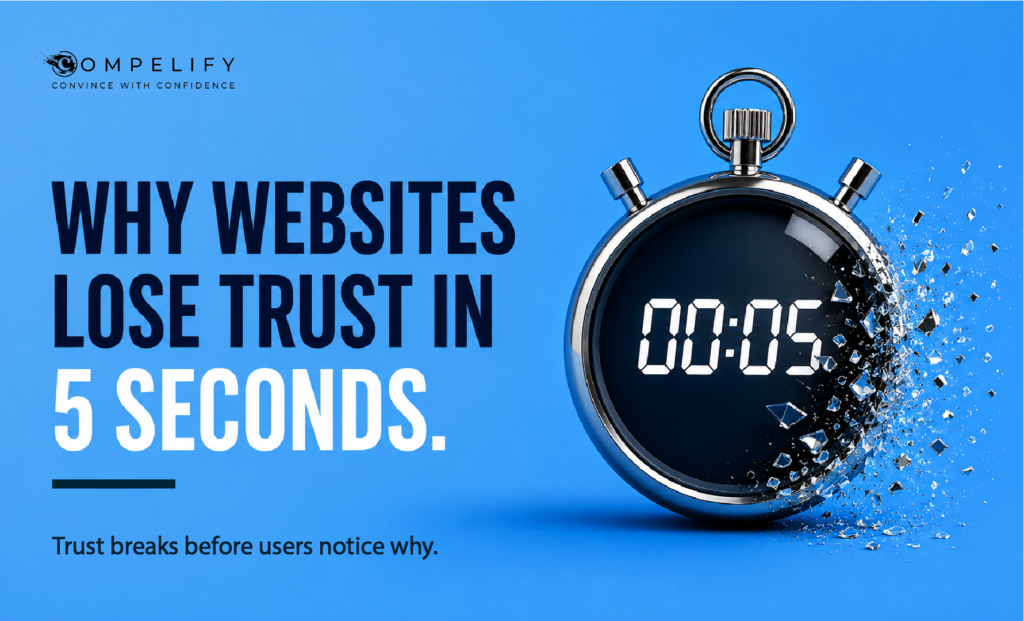
Why Websites Lose Trust In 5 Seconds
About the author
Octavia Cephalo
Brand Ambassador
Brand Ambassador
Octavia is a remarkably playful and strategic octopus that brings a unique perspective to our creative team. She expertly navigates the depths of branding, exploring the ocean, and connecting with our audience through lively social media interactions.
Featured Article
Browse By Category
Table of Contents
A website often creates the first meaningful interaction between a business and its audience.
Before a sales conversation begins, before a proposal is reviewed, and before trust has been earned through direct communication, visitors are already forming opinions based entirely on what they see in front of them. In many cases, these decisions happen far faster than businesses realize.
Research consistently shows that users form first impressions within seconds of landing on a website. Those first few moments often determine whether someone continues exploring or leaves entirely. Businesses may spend months building products, refining services, and developing marketing strategies, but if the digital experience immediately creates doubt, potential customers disappear long before deeper engagement ever begins.
The unfortunate reality is simple.
Trust can be lost almost instantly.
First Impressions Are Built Faster Than Most Businesses Expect
People naturally make quick judgments when evaluating credibility.
This behavior happens constantly, both online and offline. Consumers assess professionalism based on appearance, organization, confidence, and consistency before they fully understand what is being offered. Websites function no differently.
The moment a visitor lands on a homepage, they begin evaluating whether the business feels legitimate enough to trust.
Several factors begin influencing this decision immediately.
Does the website feel modern?
Is the messaging clear?
Does the design look polished and intentional?
Can visitors quickly understand what the company actually does?
Even subtle friction can begin weakening confidence.
Outdated design, inconsistent branding, cluttered layouts, poor mobile responsiveness, and confusing navigation all create uncertainty. While these issues may seem minor internally, users interpret them as signals about how the business itself operates.
Perception forms quickly.
And perception directly influences trust.

Poor User Experience Creates Doubt
Many organizations focus heavily on visual design while underestimating the importance of usability.
A website can look attractive while still frustrating users.
Slow load times force visitors to wait unnecessarily. Overcomplicated navigation makes information harder to find. Dense blocks of text reduce readability. Weak calls to action create uncertainty around next steps.
Every point of friction increases hesitation.
That hesitation often leads users to question whether the business itself operates with the same lack of clarity.
The challenge is that most users never consciously recognize why they leave.
They simply move on.
Businesses often assume visitors are leaving because pricing was too high or interest was low. In reality, trust may have quietly eroded during those first few seconds because the website experience created uncertainty.
Professional Design Signals Professional Capability
Websites communicate far more than information.
They communicate competence.
When users encounter a well-designed digital experience, they naturally associate that quality with the business behind it. Clean layouts, consistent branding, strong hierarchy, and intuitive navigation signal organization and professionalism.
These signals matter because buyers are constantly reducing risk when making decisions.
If a company struggles to communicate clearly online, potential customers begin wondering whether similar inconsistency exists elsewhere.
Will service quality feel inconsistent?
Will communication be slow?
Will expectations be unclear?
The website becomes a reflection of operational confidence.
This is particularly important for service-based businesses, where trust often determines whether a prospect reaches out at all.
Trust Is Built Through Clarity
The strongest websites prioritize clarity above everything else.
Visitors should immediately understand who the business serves, what problem is being solved, and what action should happen next. The experience should feel effortless.
Strong websites remove unnecessary cognitive work.
Clear messaging helps visitors process value quickly. Thoughtful design guides attention toward important information. Well-structured navigation reduces confusion. Consistent branding reinforces professionalism across every interaction.
The goal is simple.
Make it easy for people to trust what they are seeing.
Businesses sometimes focus too heavily on adding more information when what users actually need is greater clarity.
Less friction creates more confidence.
And confidence creates action.
Trust Determines Whether Conversion Ever Happens
Websites are often treated as digital brochures.
In reality, they function as trust-building systems.
Every design decision contributes to how potential customers perceive credibility. Businesses can invest heavily in advertising, lead generation, and sales strategy, but those efforts lose value quickly when website experiences fail to reinforce confidence.
Trust always comes before conversion.
The strongest digital experiences understand this relationship early. They prioritize clarity, usability, consistency, and user experience as core business drivers rather than aesthetic considerations.
Because in most cases, customers do not leave because they are uninterested.
They leave because trust disappeared before the conversation ever had a chance to begin.
And online, that can happen in less than five seconds.