We are Your Elite Creative Team To Compel Action

About the author

Octavia Cephalo

Brand Ambassador

Octavia Cephalo

Brand Ambassador

Octavia is a remarkably playful and strategic octopus that brings a unique perspective to our creative team. She expertly navigates the depths of branding, exploring the ocean, and connecting with our audience through lively social media interactions.

Follow Us

Contact Us

Would you like your creative
collateral to be more compelling?

Table of Contents

Successful events require momentum.

Organizations spend months building brand awareness, developing promotional campaigns, announcing speakers, creating marketing assets, and generating excitement designed to drive strong attendance once registration opens. Teams carefully invest time and budget into creating experiences intended to attract the right audience while building anticipation long before event day finally arrives.

Then registration opens.

And attendance numbers begin falling short of expectations.

For many organizations, the immediate assumption is simple. Marketing efforts must not have performed strongly enough. Audience interest may have been lower than expected. Messaging may need improvement. Pricing may be discouraging participation.

In many cases, however, the real problem begins somewhere far less obvious.

Registration friction.

Even when audiences feel genuinely interested in attending, small barriers inside the registration process often create hesitation strong enough to stop people from completing the process entirely. The event itself remains appealing.

The registration experience quietly becomes the obstacle.

Interest Does Not Guarantee Conversion

Generating attention is only part of the challenge.

Event organizers often focus heavily on awareness, assuming interested audiences will naturally complete registration once the opportunity becomes available. Unfortunately, interest alone rarely guarantees action.

Every registration process requires commitment.

Attendees are being asked to stop what they are doing, process information, make scheduling decisions, share personal information, and actively commit time toward an experience that may not happen for weeks or even months. This naturally creates hesitation.

The easier the process feels, the more likely attendees are to follow through.

The more complicated the process becomes, the more likely audiences begin delaying decisions.

And delayed decisions frequently become abandoned registrations entirely.

The audience wants to attend.

The process itself interrupts momentum.

Small Friction Points Create Major Drop Off

Registration friction rarely appears dramatic.

In most cases, small inconveniences quietly begin adding resistance throughout the process.

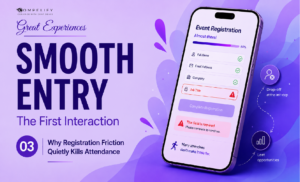
Forms request too much information. Mobile registration experiences feel poorly optimized. Ticketing platforms force unnecessary account creation. Multiple registration pages create confusion around progress. Pricing information feels unclear. Payment systems introduce avoidable technical frustration.

Individually, these problems may feel minor.

Collectively, they begin increasing cognitive effort.

This matters because online behavior is highly sensitive to friction. The moment users feel forced to work harder than expected, hesitation begins increasing. Attention starts shifting elsewhere. The urgency that initially created motivation disappears surprisingly quickly.

The audience simply leaves.

Often without consciously realizing why.

Complicated Registration Creates Unnecessary Risk

Attending an event requires confidence.

Unlike casual website browsing, registration often represents a stronger commitment involving time, scheduling, travel, internal approval, or direct financial investment. This naturally increases decision sensitivity.

Complicated registration processes make that commitment feel riskier.

When attendees encounter confusing forms, unclear instructions, excessive steps, or technical frustration, subconscious doubt begins growing. The registration experience starts influencing how the audience perceives the event itself.

A frustrating registration process raises quiet questions.

Will the event itself feel disorganized?

Will communication be inconsistent?

Will the overall experience reflect the same operational confusion?

The event may be excellent.

But friction during registration quietly weakens confidence before attendees ever commit.

Small process problems begin damaging trust.

Simplicity Protects Conversion Momentum

Strong event experiences prioritize simplicity.

The registration process should feel effortless. Attendees should understand exactly what is being asked, how long the process will take, and what happens immediately after registration is completed.

Every unnecessary step increases risk.

The strongest event teams intentionally reduce friction by simplifying forms, minimizing required information, optimizing mobile experiences, streamlining payment processes, and removing any barriers capable of slowing momentum unnecessarily.

This preserves conversion energy.

When someone decides they want to attend, the process should support that decision rather than forcing them to reconsider along the way.

Simple systems protect momentum.

And momentum directly influences attendance performance.

Great Events Remove Friction Before It Costs Results

Successful events depend on more than strong branding and effective marketing.

Even when organizations build anticipation successfully and generate meaningful audience interest, results can quietly suffer when registration systems fail to support the final conversion process effectively.

The strongest event teams understand this relationship early.

They recognize that registration is not simply an administrative step designed to collect attendee information.

It is a critical part of the event experience itself.

Because audiences rarely abandon registration because they suddenly lose interest.

More often, they leave because unnecessary friction quietly interrupted the momentum that originally motivated them to act.

And every abandoned registration represents lost opportunity that strong event strategy worked hard to create in the first place.

Sometimes the difference between full attendance and disappointing turnout comes down to a few unnecessary clicks.

And those clicks often cost far more than organizations realize.