We are Your Elite Creative Team To Compel Action

About the author

Octavia Cephalo

Brand Ambassador

Octavia Cephalo

Brand Ambassador

Octavia is a remarkably playful and strategic octopus that brings a unique perspective to our creative team. She expertly navigates the depths of branding, exploring the ocean, and connecting with our audience through lively social media interactions.

Follow Us

Contact Us

Would you like your creative
collateral to be more compelling?

Table of Contents

Businesses often invest heavily in marketing with the expectation that stronger visibility will automatically produce stronger growth. Teams launch advertising campaigns, build social media calendars, redesign websites, create sales materials, and spend significant time refining messaging intended to attract new customers.

Yet many organizations struggle to build lasting momentum.

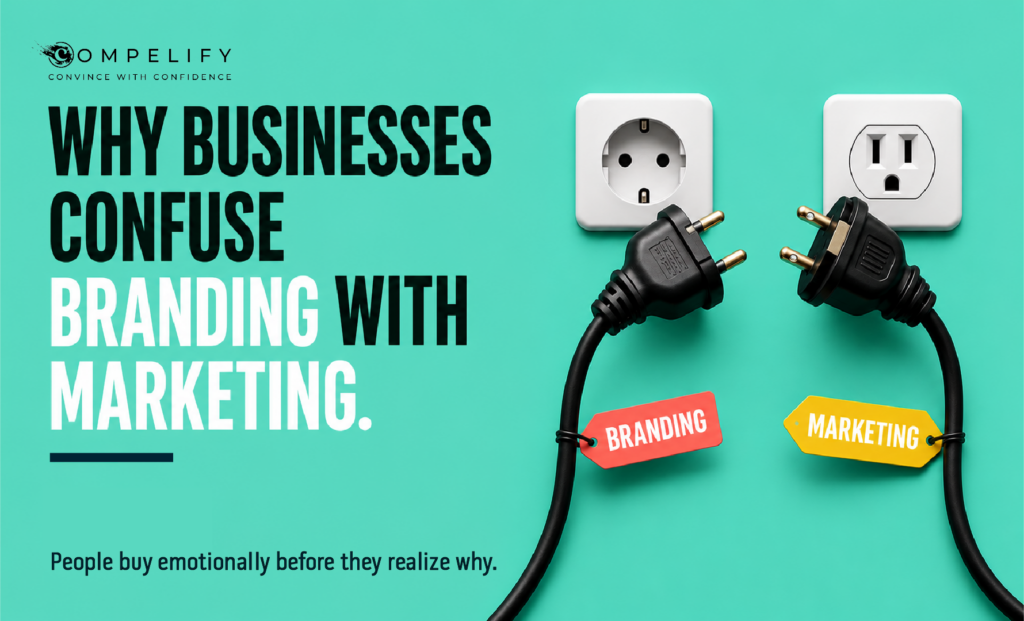
The problem is not always the quality of the marketing itself. In many cases, businesses begin executing marketing activities long before establishing the foundation necessary to support those efforts. The underlying issue is simple. Many companies confuse branding with marketing, treating the two as interchangeable when they serve entirely different business functions.

While both play critical roles in growth, misunderstanding the difference often leads to inconsistent messaging, weaker customer trust, and campaigns that fail to perform as effectively as they should.

Understanding the distinction changes how businesses communicate, position themselves, and ultimately compete in crowded markets.

Branding Shapes Perception. Marketing Creates Visibility

Branding and marketing are closely connected, but they are not the same thing.

Branding defines how a business is perceived. It establishes identity, communicates values, creates emotional connection, and helps customers understand what makes the organization different. A strong brand creates familiarity and shapes how people feel whenever they interact with the business.

Marketing serves a different purpose.

Marketing exists to promote the business by driving awareness, generating interest, and moving audiences toward action. Campaigns, advertisements, content strategy, email outreach, paid media, and lead generation all function as marketing tools designed to create visibility.

One builds perception.

The other creates attention.

Businesses often invest heavily in marketing activity while overlooking the brand foundation supporting those efforts.

The result is frequently inconsistent communication and weaker long-term growth.

Strong Marketing Cannot Fix Weak Brand Positioning

Marketing can amplify a message.

It cannot fix an unclear one.

Businesses sometimes focus heavily on generating traffic without first establishing what the audience should actually understand once they arrive. Teams launch campaigns designed to increase reach, but if the brand itself lacks clarity, visibility alone rarely solves the problem.

Customers need confidence before making decisions.

If messaging feels inconsistent, positioning feels unclear, or the business struggles to communicate what differentiates it from competitors, stronger marketing simply exposes those weaknesses faster.

This is one of the most common growth mistakes organizations make.

More advertising does not automatically create stronger results.

If the brand foundation lacks clarity, performance eventually suffers no matter how much marketing activity increases.

Branding Builds Trust Before Marketing Begins Working

Every customer interaction contributes to perception.

Long before someone clicks an advertisement or engages with a marketing campaign, subconscious judgments are already forming based on how the business presents itself. Visual identity, messaging consistency, tone of communication, and overall professionalism begin influencing trust immediately.

This is where branding becomes critical.

A strong brand helps audiences feel familiarity and confidence before active marketing efforts ever begin driving attention. It establishes credibility early, making future campaigns more effective because customers already feel more comfortable engaging with the business.

Without strong branding, marketing has to work significantly harder.

Audiences may discover the business, but uncertainty often prevents deeper engagement.

Trust is difficult to build when the brand itself feels inconsistent.

Businesses Often Prioritize Short Term Growth Over Long Term Equity

Marketing often produces measurable short-term results.

Campaign performance can be tracked. Website traffic can be monitored. Leads can be measured. Return on investment becomes visible relatively quickly.

Branding operates differently.

Its impact compounds over time.

A strong brand increases recognition, strengthens loyalty, improves trust, supports pricing power, and creates consistency across every future marketing effort. While those results are harder to measure immediately, they often influence long-term growth more significantly than individual campaigns.

Businesses sometimes overlook this because marketing feels more immediate.

It creates activity.

Branding creates foundation.

The strongest organizations understand that both are necessary, but they build brand clarity first so marketing efforts perform more efficiently over time.

Growth Happens When Branding And Marketing Work Together

Businesses rarely struggle because marketing is ineffective.

More often, growth stalls because the foundation supporting that marketing was never fully developed.

Branding defines how customers perceive value. Marketing helps customers discover that value. When these two systems work together, businesses create stronger trust, stronger engagement, and stronger long-term momentum.

The mistake happens when organizations prioritize visibility before clarity.

Marketing can drive traffic.

It can create awareness.

It can generate opportunity.

But without strong branding supporting those efforts, businesses often spend more resources fighting for attention while struggling to build meaningful trust.

The most successful companies understand the relationship early.

Branding creates the foundation.

Marketing amplifies it.

And when businesses stop confusing the two, growth becomes far easier to sustain.