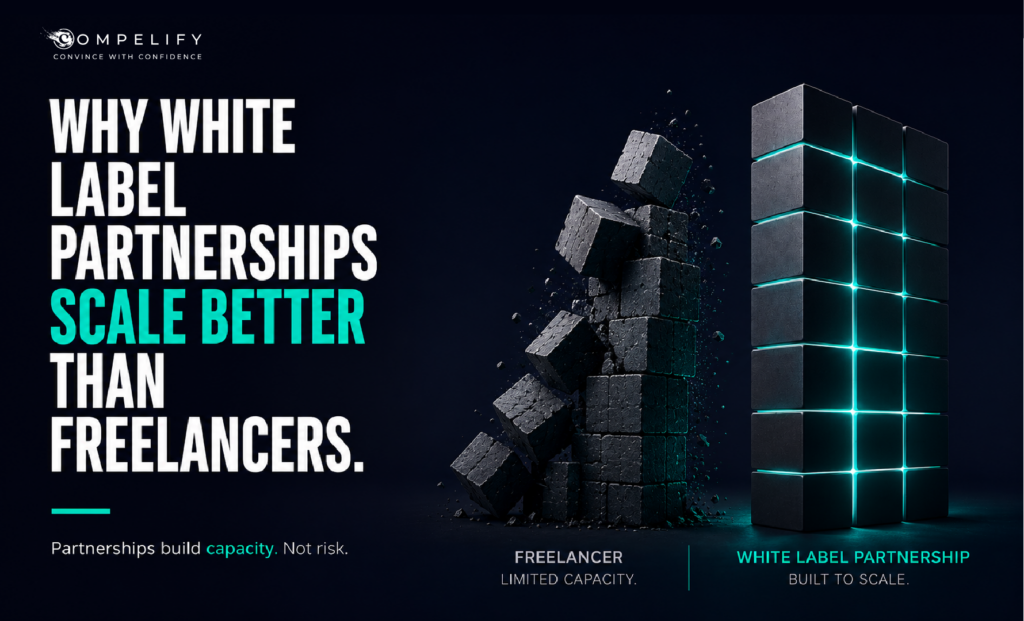
Why White Label Partnerships Scale Better Than Freelancers
About the author
Octavia Cephalo
Brand Ambassador
Brand Ambassador
Octavia is a remarkably playful and strategic octopus that brings a unique perspective to our creative team. She expertly navigates the depths of branding, exploring the ocean, and connecting with our audience through lively social media interactions.
Featured Article
Browse By Category
Table of Contents
Growth creates pressure.
For agencies, one of the earliest signs of growth often looks positive on the surface. New clients begin coming in, project volume increases, and internal teams suddenly find themselves balancing more work than existing capacity comfortably allows. Momentum builds quickly, but so does operational strain.
This is often the point where agency leaders begin looking for outside support.
For many growing teams, freelancers become the obvious first solution. They offer flexibility, can be hired quickly, and appear to solve immediate production bottlenecks without requiring long-term overhead. While freelancers can absolutely provide short-term value, many agencies eventually discover the same limitation.
Freelancers help complete tasks.
They rarely solve scale.
As agencies grow, sustainable capacity requires more than temporary execution support. This is where white label partnerships often create far stronger long-term value.
Freelancers Solve Immediate Needs, Not Operational Growth
Freelancers serve an important role in the modern creative ecosystem.
They allow agencies to fill skill gaps quickly, handle overflow work during busy periods, and reduce the burden placed on internal teams when deadlines begin stacking faster than capacity allows. For project-based support, freelancers often make perfect sense.
The challenge begins when growth becomes consistent.
Scaling agencies rarely struggle because of individual project execution. More often, operational pressure builds because client demand becomes increasingly difficult to manage consistently across multiple accounts, deadlines, revisions, and deliverables.
Freelancers typically operate independently.
They focus on completing assigned work rather than integrating deeply into agency systems, communication workflows, or long-term production processes. While this works well for isolated tasks, it often creates fragmentation as agency volume continues increasing.
The business grows.
The operational model does not.

Scaling Requires Capacity You Can Depend On
Agency growth introduces complexity quickly.
More clients mean more communication cycles. More deliverables create more revisions. Timelines begin overlapping. Account managers spend more time coordinating production while leadership shifts focus away from growth and toward managing workflow bottlenecks.
This is where dependable capacity becomes critical.
Unlike freelance relationships that often operate independently, white label partnerships function more like integrated extensions of the agency itself. Production becomes repeatable. Communication becomes consistent. Workflows become standardized.
Instead of constantly sourcing individual contributors for isolated tasks, agencies build reliable systems designed to support ongoing growth.
Consistency creates operational stability.
And operational stability allows agencies to scale more confidently.
Strong Partnerships Reduce Management Overhead
One of the most overlooked challenges of freelance-based growth is management burden.
Every freelancer operates differently.
Communication preferences vary. Turnaround times fluctuate. Quality standards may differ between contributors. Agency teams often spend more time coordinating freelancers than originally expected, particularly as project volume increases.
This creates hidden operational costs.
While freelancers may reduce immediate production pressure, leadership frequently absorbs the burden through increased oversight, project management complexity, and inconsistent output across client accounts.
White label partnerships operate differently.
Because the relationship is designed around long-term collaboration, production systems begin aligning more naturally over time. Expectations become clearer. Communication improves. Quality standards become consistent.
The agency spends less time managing execution and more time focusing on client growth.
Clients Expect Consistency As Agencies Grow
Scaling successfully requires more than simply completing more work.
Client expectations rise alongside agency growth.
As agencies begin managing larger accounts, consistency becomes increasingly important. Deliverables need to maintain quality standards regardless of project volume. Timelines need to remain predictable. Client experiences need to feel seamless across every engagement.
Freelance-heavy production models sometimes struggle under this pressure.
Different contributors often produce slightly different results. Design styles may shift unexpectedly. Communication delays begin affecting timelines. Internal teams spend more energy protecting consistency instead of driving growth.
White label partnerships help solve this by creating production systems designed around repeatability.
Consistency becomes part of the operating model itself.
And consistency strengthens client trust.
Sustainable Growth Depends On Scalable Systems
Growing agencies often focus heavily on acquiring new business.
The more important challenge usually comes later.
Can the business continue delivering consistently as demand increases?
Freelancers can provide valuable flexibility, particularly during early growth stages. But sustainable scale requires systems that reduce operational friction rather than adding more moving parts.
White label partnerships create dependable capacity.
They reduce management complexity, improve consistency, strengthen delivery systems, and allow agencies to grow without forcing leadership to rebuild operational processes every time demand increases.
The strongest agencies understand this early.
Growth rarely breaks because demand disappears.
It breaks when the systems supporting that demand fail to scale alongside it.
And the agencies that scale successfully build partnerships designed to grow with them.