We are Your Elite Creative Team To Compel Action

About the author

Octavia Cephalo

Brand Ambassador

Octavia Cephalo

Brand Ambassador

Octavia is a remarkably playful and strategic octopus that brings a unique perspective to our creative team. She expertly navigates the depths of branding, exploring the ocean, and connecting with our audience through lively social media interactions.

Follow Us

Contact Us

Would you like your creative
collateral to be more compelling?

Table of Contents

Creative teams thrive on momentum.

Designers, marketers, developers, strategists, and production teams perform best when ideas move efficiently from concept to execution. Projects stay organized, communication remains clear, approvals happen on schedule, and teams can focus on producing high-quality work without unnecessary friction slowing progress.

Unfortunately, many growing organizations create the exact opposite environment.

As businesses scale, operational complexity begins increasing faster than internal systems can adapt. Workflows become less efficient, communication becomes fragmented, approval processes begin slowing down, and teams spend more time managing operational friction than doing the actual work they were hired to do.

The result is a problem many organizations fail to recognize early enough.

Creative teams begin breaking down.

In most cases, the issue is not talent.

It is operational inefficiency quietly disrupting how that talent performs every day.

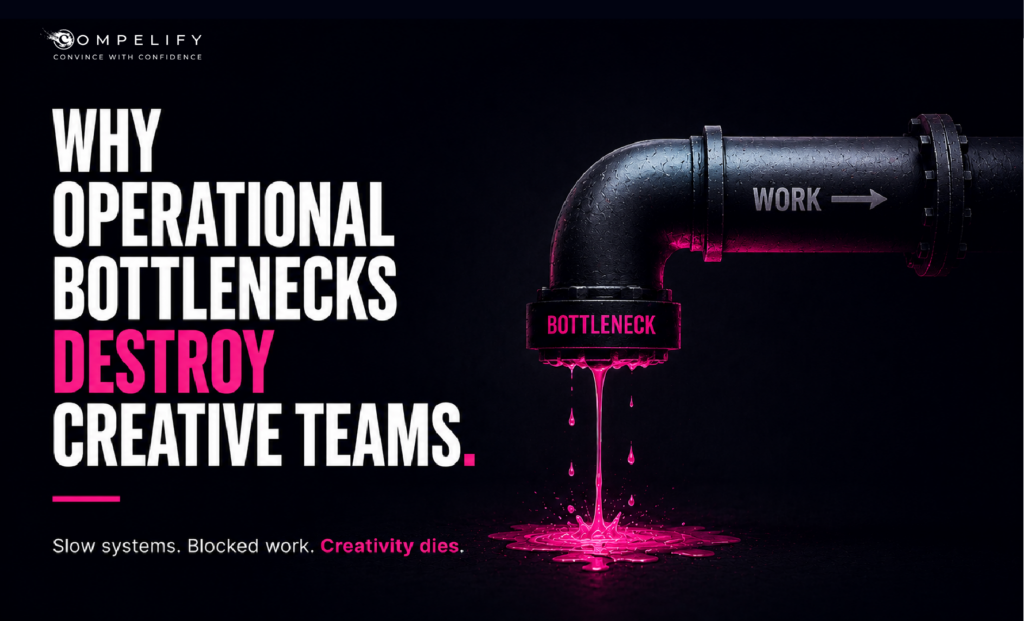
Bottlenecks Reduce Momentum Across The Entire Team

Creative work depends heavily on flow.

Projects move through multiple stages before completion. Strategy needs approval. Concepts move into design. Design moves into review. Feedback returns for revisions. Final deliverables move toward launch. Every step relies on efficient coordination between people, systems, and decision makers.

Bottlenecks disrupt this process immediately.

A delayed approval can stall an entire project. Missing communication forces teams to wait unnecessarily. Poor task management creates confusion around ownership and accountability. Multiple projects begin competing for the same internal resources without clear prioritization.

Small delays begin compounding quickly.

Teams lose momentum not because the work itself becomes difficult, but because operational friction prevents work from moving efficiently.

The creative process slows long before talent ever becomes the limiting factor.

Talented Teams Become Frustrated Inside Broken Systems

Most organizations assume performance issues originate with people.

In reality, many creative teams underperform because the systems surrounding them make efficient work impossible.

Talented designers cannot work effectively when priorities shift constantly. Marketing teams struggle when campaign timelines change without clear communication. Developers lose efficiency when project requirements continue evolving mid-production. Project managers spend increasing time resolving operational confusion rather than keeping work moving forward.

Over time, frustration begins growing.

The team feels busy, but productivity starts declining.

This creates one of the most dangerous operational patterns businesses experience.

Leadership sees people working harder while output begins slowing down.

The natural assumption becomes resource limitations.

In many cases, the real problem is operational design.

The system itself has become inefficient.

Bottlenecks Quietly Create Capacity Problems

Operational bottlenecks rarely stay isolated.

When one part of the workflow begins slowing down, pressure spreads quickly across the rest of the organization.

Projects begin stacking faster than teams can complete them. Deadlines become harder to manage because internal schedules continue shifting unpredictably. Resources originally assigned to future work remain tied up resolving delays created by earlier workflow problems.

Capacity begins shrinking.

This often confuses leadership teams.

Revenue may continue growing. Team size may increase. More resources may be added internally. Yet productivity still feels constrained despite increasing investment.

The reason is simple.

More people do not automatically solve inefficient systems.

If workflows remain broken, adding resources simply introduces more complexity into an already inefficient operating model.

The bottleneck remains unchanged.

The organization simply becomes more expensive.

Strong Operations Protect Creative Performance

High-performing creative teams rely on strong operational systems.

Workflows need clear ownership. Communication channels need consistency. Approval processes should move quickly and predictably. Project timelines need structure that reduces unnecessary delays while allowing teams to focus on execution rather than coordination.

Strong operations create stability.

This stability allows creative teams to perform at their highest level because energy remains focused on producing work instead of navigating internal friction.

The strongest organizations understand this relationship early.

Creative performance is rarely determined by talent alone.

The systems supporting that talent directly influence how consistently teams can execute.

When operations improve, performance improves alongside them.

Broken Systems Quietly Cost More Than Businesses Realize

Operational bottlenecks rarely create immediate failure.

That is what makes them dangerous.

The business often continues functioning while inefficiencies slowly begin compounding underneath the surface. Deadlines slip more frequently. Team frustration increases. Client communication becomes less consistent. Productivity gradually declines even while teams remain fully occupied.

Eventually, growth begins slowing.

Leadership often responds by hiring more people, increasing oversight, or expanding internal resources.

But none of those decisions solve the underlying issue.

Creative teams rarely struggle because they lack talent.

More often, they struggle because the systems surrounding them force good people to work inefficiently every day.

The strongest businesses understand that creative performance and operational performance are directly connected.

Because when workflows begin breaking down, talent alone cannot protect momentum.

And operational bottlenecks will eventually destroy even the strongest creative teams if the systems behind them are never designed to scale.