We are Your Elite Creative Team To Compel Action

About the author

Octavia Cephalo

Brand Ambassador

Octavia Cephalo

Brand Ambassador

Octavia is a remarkably playful and strategic octopus that brings a unique perspective to our creative team. She expertly navigates the depths of branding, exploring the ocean, and connecting with our audience through lively social media interactions.

Follow Us

Contact Us

Would you like your creative
collateral to be more compelling?

Table of Contents

Businesses spend enormous amounts of time thinking about products, services, pricing, and marketing strategy. Teams focus on improving offers, refining messaging, optimizing campaigns, and building stronger customer experiences, all with the same ultimate goal in mind: increasing sales.

Yet many organizations still misunderstand one of the most important factors influencing whether customers actually buy.

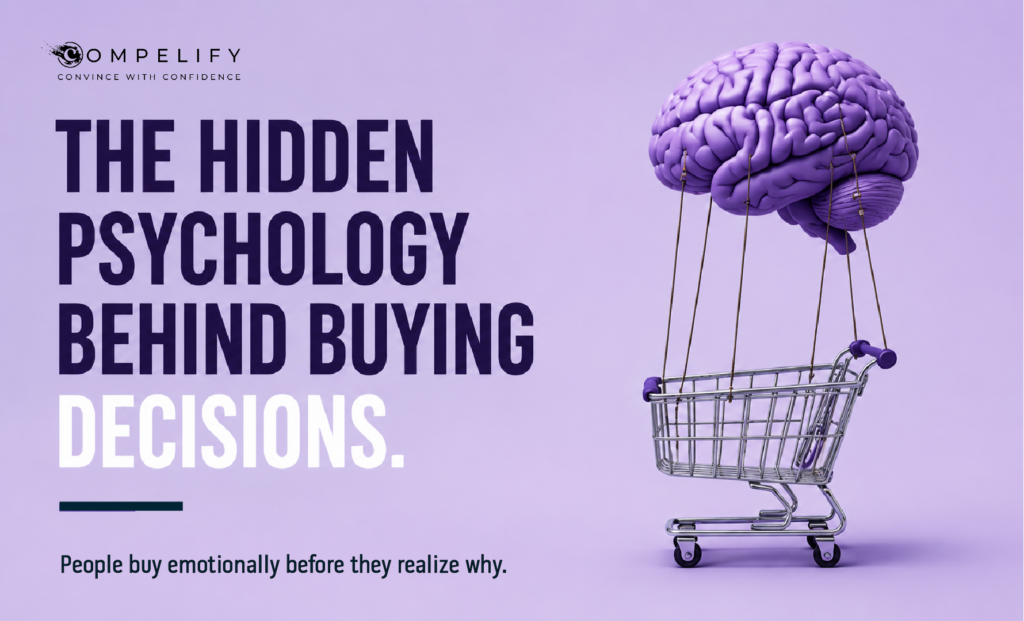
Buying decisions are rarely based on logic alone.

While businesses often assume consumers carefully compare options, evaluate value objectively, and make rational purchasing decisions, human behavior tells a very different story. Most buying decisions happen emotionally first, while logic simply helps justify the decision afterward.

Understanding this shift changes how businesses approach marketing, branding, design, and communication.

Because purchasing behavior has always been driven by psychology long before it is driven by information.

Emotion Often Drives Decisions Before Logic Ever Begins

Consumers like to believe they make rational choices.

In reality, emotional response often shapes decision making long before conscious analysis takes over. People naturally gravitate toward products, services, and brands that create feelings of trust, confidence, familiarity, or excitement.

This happens constantly, even during seemingly logical purchasing decisions.

A business leader evaluating service providers may choose the company that feels more established, even if competing options offer similar capabilities. A consumer shopping online may trust the brand that appears more polished, even if lower-cost alternatives exist. Buyers consistently respond to emotional signals before fully processing objective information.

The emotional response happens first.

Logic simply helps justify why the decision feels correct.

Businesses that ignore this reality often struggle to understand why their strongest offers fail to convert.

Trust Reduces Perceived Risk

Every purchase involves uncertainty.

Whether someone is buying a product, selecting a software platform, or choosing a service provider, they are constantly evaluating risk. The buyer wants confidence that the decision will lead to a positive outcome and avoid unnecessary mistakes.

Trust helps reduce that uncertainty.

This is why branding, design quality, messaging consistency, and presentation matter far more than many businesses realize. Buyers often make assumptions about professionalism based on visual and emotional signals before evaluating the actual offer itself.

A polished website immediately feels more credible.

Consistent branding reinforces confidence.

Clear communication creates a sense of competence.

Even before a customer fully understands the offer being presented, trust is already influencing how they interpret value.

Perception directly affects decision making.

Familiarity Creates Comfort

Human behavior naturally favors familiarity.

Consumers feel more comfortable engaging with brands that communicate clearly and consistently across every touchpoint. Repetition creates recognition, and recognition strengthens confidence.

This principle explains why consistency matters so heavily in marketing.

A customer may first encounter a business through an advertisement, later visit its website, browse social media content, receive follow-up communication, and eventually begin considering a purchase decision. Every interaction contributes to familiarity.

When the brand experience feels disconnected, uncertainty begins to grow.

Inconsistent messaging creates hesitation.

Conflicting design styles weaken recognition.

Poor communication makes the buyer work harder to understand what is being offered.

Consistency reduces friction by helping the audience feel comfortable with what they already recognize.

Comfort often moves people closer to action.

Decision Fatigue Quietly Impacts Conversion

Many businesses unintentionally overwhelm buyers.

Websites become crowded with too many options. Landing pages present excessive information. Sales processes create unnecessary complexity. Marketing campaigns attempt to communicate too many messages at once.

The result is decision fatigue.

When people feel forced to process too much information, confidence begins to decline. Rather than moving toward action, buyers often delay decisions entirely.

This is why simplicity matters.

The strongest customer experiences remove unnecessary friction by reducing cognitive overload. Clear messaging, intentional design hierarchy, focused calls to action, and streamlined decision paths help customers feel confident moving forward.

The easier a decision feels, the more likely people are to act.

Complexity creates hesitation.

Simplicity builds momentum.

Businesses That Understand Psychology Create Better Results

Successful brands understand that buying decisions are rarely transactional.

Customers are constantly evaluating trust, familiarity, confidence, and emotional comfort long before logic begins influencing the final decision. Businesses that recognize this reality approach marketing differently.

They build experiences intentionally.

Every touchpoint is designed to reinforce credibility. Messaging is structured to create clarity. Branding remains consistent across every interaction. Customer journeys are simplified to reduce friction wherever possible.

The strongest businesses understand a simple truth.

People rarely buy because they fully understand every feature or benefit.

They buy when they feel confident enough to believe they are making the right decision.

And businesses that understand the psychology behind that decision consistently outperform those that focus on logic alone.

Because in the end, people may justify purchases rationally.

But they almost always decide emotionally first.