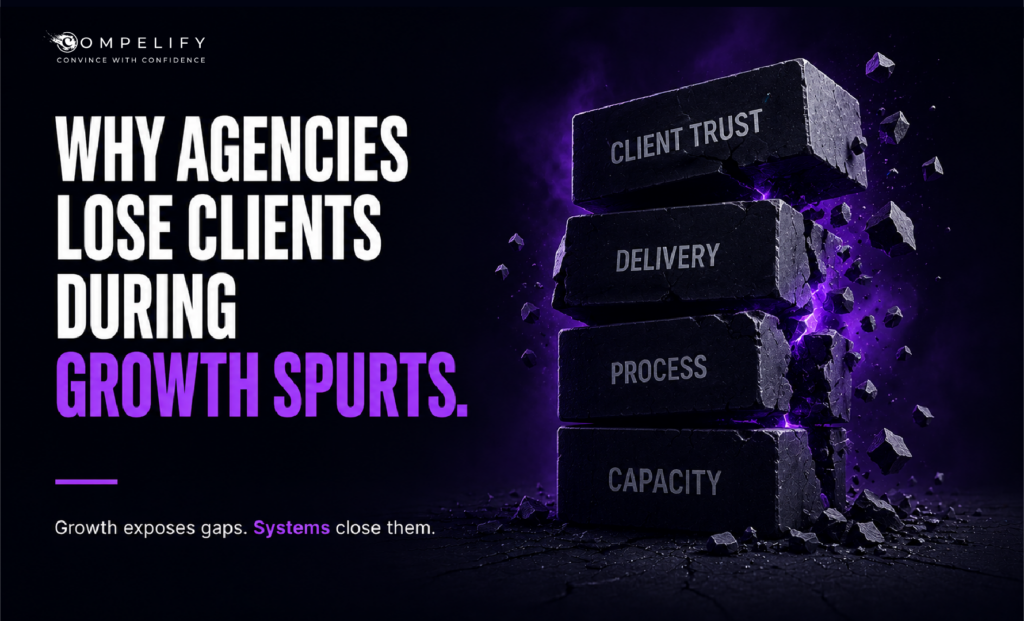
Why Agencies Lose Clients During Growth Spurts
About the author
Octavia Cephalo
Brand Ambassador
Brand Ambassador
Octavia is a remarkably playful and strategic octopus that brings a unique perspective to our creative team. She expertly navigates the depths of branding, exploring the ocean, and connecting with our audience through lively social media interactions.
Featured Article
Browse By Category
Table of Contents
Growth is usually viewed as a sign that an agency is doing something right.
New clients begin signing, project volume increases, referrals start accelerating, and revenue trends upward. From the outside, this stage often looks like success. Agency leaders spend months working toward this exact moment, building systems designed to generate more opportunities and expand capacity over time.
Yet growth often introduces a problem many agencies fail to anticipate.
The very momentum that creates expansion can quietly begin damaging client relationships.
Agencies rarely lose clients during periods of stability. More often, client churn begins appearing during rapid growth periods, when internal systems struggle to keep pace with increasing demand. The agency continues focusing on acquisition while operational cracks begin forming behind the scenes.
Clients may not notice immediately.
But they eventually feel the difference.
Growth Often Creates Operational Strain Before Leadership Recognizes It
Winning new business naturally increases complexity.
More clients means more meetings, more deliverables, more communication cycles, more revision requests, and more internal coordination required to keep projects moving efficiently. Workload expands quickly, but internal processes do not always evolve at the same speed.
This is where operational pressure begins building.
Leadership teams often remain focused on revenue growth while internal teams quietly absorb the strain. Project managers begin juggling competing deadlines. Designers handle increasing workloads. Communication becomes less organized as more projects compete for attention.
The agency may continue growing financially.
But internally, the operating system begins falling behind.
Growth itself is not the problem.
The inability to scale operations alongside growth is what creates risk.
Client Experience Changes Long Before Clients Leave
Most agencies assume client churn happens because a project underperformed or because the quality of work declined significantly.
In reality, dissatisfaction usually builds gradually.
Clients begin noticing slower response times. Feedback cycles take longer than expected. Communication feels less proactive. Small deliverables begin missing deadlines that previously felt routine. Revision requests require additional follow-up instead of moving smoothly through production.
Individually, these problems may feel minor.
Collectively, they begin changing how clients experience the relationship.
This shift matters because clients often evaluate agencies based on reliability just as much as creative quality. Even when the work itself remains strong, inconsistent communication and operational friction begin weakening confidence.
Trust erodes slowly.
And once consistency disappears, client retention becomes increasingly difficult.
Growing Agencies Often Prioritize Acquisition Over Retention
One of the most common operational mistakes agencies make during growth is focusing too heavily on bringing in new business while unintentionally neglecting existing relationships.
This happens naturally.
Sales efforts accelerate. Leadership attention shifts toward closing larger accounts. Internal teams become increasingly focused on onboarding new projects while existing clients receive less direct attention than before.
The agency remains busy.
But the client experience begins changing.
Long-term clients often notice this shift quickly. The responsiveness that originally built trust begins fading. Collaboration feels less personal. Communication becomes increasingly reactive rather than proactive.
Ironically, the same growth agencies work hard to create can begin damaging the relationships responsible for that growth in the first place.
Retention begins suffering while acquisition remains the primary focus.
Scaling Requires Systems That Protect Consistency
Successful agencies understand that growth introduces operational responsibility.
The goal is never simply adding more clients.
The goal is maintaining consistent delivery while demand increases.
This requires systems designed to protect client experience even when workloads expand rapidly. Communication processes need to remain reliable. Internal workflows need to reduce production bottlenecks. Team responsibilities need to stay clearly defined as volume increases.
Consistency should never become optional simply because growth creates additional pressure.
The strongest agencies build infrastructure before operational strain begins affecting delivery.
When systems remain stable, growth becomes sustainable.
When systems begin breaking under pressure, clients feel the consequences quickly.
Growth Means Nothing If Clients Stop Trusting The Process
Agency growth should strengthen momentum.
Unfortunately, many agencies unknowingly create the opposite effect.
New business increases, but operational systems fail to evolve quickly enough to support rising demand. Teams become stretched too thin. Client communication begins slipping. Delivery consistency weakens. Long-term relationships quietly begin deteriorating while leadership remains focused on continued expansion.
Growth without operational stability creates fragile businesses.
The agencies that scale successfully understand a simple principle.
Winning new clients matters.
Keeping existing clients matters more.
Because agencies rarely lose clients because the creative work suddenly became worse.
They lose clients when growth creates an experience that no longer feels consistent, reliable, or trustworthy.
And once trust begins slipping, client retention becomes far more difficult to recover.