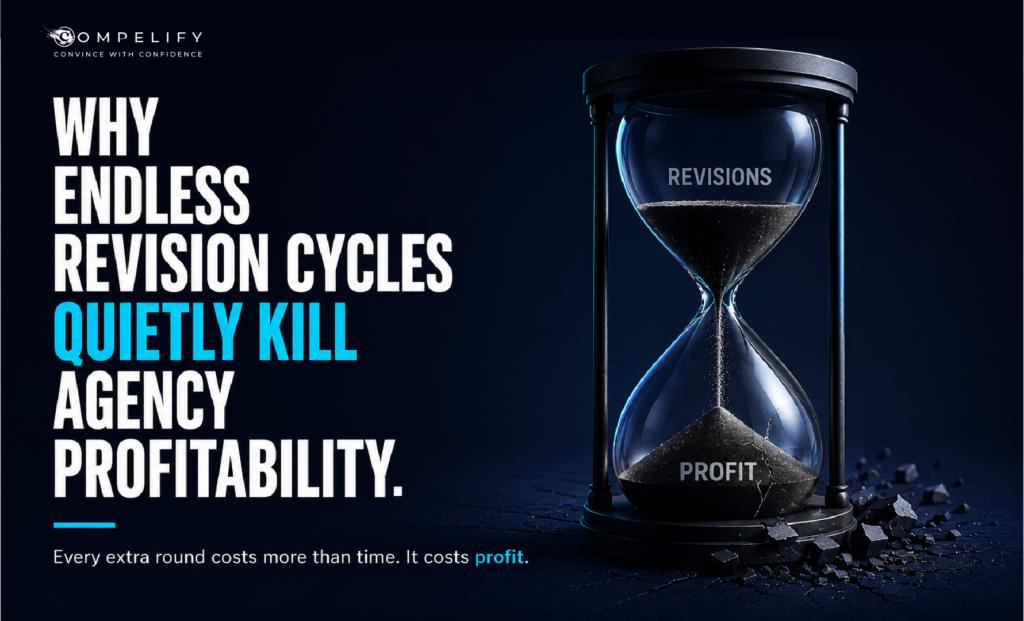
Why Endless Revision Cycles Quietly Kill Agency Profitability
About the author
Octavia Cephalo
Brand Ambassador
Brand Ambassador
Octavia is a remarkably playful and strategic octopus that brings a unique perspective to our creative team. She expertly navigates the depths of branding, exploring the ocean, and connecting with our audience through lively social media interactions.
Featured Article
Browse By Category
Table of Contents
Most agencies understand revisions as part of the creative process.
Clients provide feedback, teams make adjustments, ideas evolve, and deliverables improve through collaboration. In healthy client relationships, revisions help refine creative work and ensure final outcomes align with expectations. On the surface, the process feels entirely normal and often necessary.
The problem begins when revision cycles stop being structured.
What starts as normal collaboration can quickly become an operational issue that agencies quietly absorb without fully recognizing the financial impact. Small rounds of feedback begin multiplying. Timelines extend further than originally scoped. Internal teams spend additional hours revisiting work that technically should have already been completed.
The client sees continued progress.
The agency absorbs shrinking profitability.
While revisions often feel like part of doing business, unmanaged revision cycles create one of the most overlooked threats to agency margins.
Creative Work Becomes Unprofitable Faster Than Most Agencies Realize
Most agency pricing models are built around estimated labor.
Project timelines, internal production costs, and expected team capacity all influence how work is scoped and priced. Profitability depends heavily on keeping production within those expected boundaries.
Excessive revisions quietly disrupt that balance.
A project originally scoped for twenty hours may gradually become thirty. Thirty becomes forty. Designers revisit concepts repeatedly while project managers coordinate additional feedback rounds, update timelines, and manage shifting client expectations.
The project itself may still feel successful.
Internally, however, profitability begins disappearing.
This problem becomes particularly dangerous because agencies rarely track revision costs accurately. Additional work often feels small in isolation, making it easy to overlook how quickly labor hours begin compounding across multiple client accounts.
The project continues moving forward.
The margin slowly disappears behind the scenes.

Unclear Scope Creates Endless Feedback Loops
Revision problems rarely begin with difficult clients.
More often, the issue starts during project scoping.
When deliverables, expectations, and approval processes are not clearly defined from the beginning, feedback cycles naturally become less structured. Clients continue refining because boundaries were never established clearly enough to define when work is considered complete.
This creates open-ended collaboration.
Teams receive broad subjective feedback rather than actionable revisions. Stakeholders continue introducing new opinions late in the process. Small changes begin stacking repeatedly, forcing designers and production teams to revisit work far beyond the original scope.
Without structure, revision cycles can continue indefinitely.
The agency remains focused on client satisfaction.
The project quietly becomes less profitable with every additional round.
Internal Teams Absorb The Operational Cost
Excessive revisions rarely impact just one department.
Designers spend more time revisiting completed work. Project managers handle additional communication cycles. Leadership becomes increasingly involved as timelines shift and clients begin requesting expanded changes beyond original expectations.
This creates operational strain across the entire organization.
Team capacity begins shrinking because internal resources remain tied up longer than expected. Other client projects receive less attention as production schedules begin overlapping. Deadlines become harder to maintain because resources originally allocated for new work remain trapped inside existing projects.
Over time, this creates a dangerous operational pattern.
The agency stays busy.
Revenue may continue growing.
But team capacity steadily decreases because too much internal time is being consumed by work that no longer generates additional value.
Busy does not always mean profitable.
Strong Systems Protect Agency Margins
The most profitable agencies understand that revisions require structure.
Healthy collaboration should improve outcomes without creating unlimited production cycles. This requires setting clear expectations early and building systems designed to control how feedback moves through production.
Well-defined project scopes reduce ambiguity. Approval processes establish decision-making boundaries. Revision limits create accountability around feedback cycles while encouraging more intentional client communication throughout the process.
The goal is not eliminating revisions.
The goal is preventing revisions from quietly consuming operational capacity.
Agencies that protect profitability build systems designed to preserve margin at every stage of delivery.
Structure creates predictability.
Predictability protects scale.
Profitability Depends On Protecting Capacity
Agency growth depends on more than bringing in new revenue.
Long-term profitability requires protecting how internal resources are being used every day. Endless revision cycles often feel harmless because client relationships remain positive and projects continue moving forward.
But internally, the business begins paying for work repeatedly.
Additional labor hours reduce margin. Team capacity decreases. Operational pressure increases as more resources become trapped inside projects that should have already moved toward completion.
The strongest agencies recognize this early.
Client collaboration should improve outcomes, but collaboration without structure quickly becomes expensive.
Because agencies rarely lose profitability through one major mistake.
More often, profit disappears through small inefficiencies repeated consistently over time.
And endless revision cycles remain one of the quietest ways agencies allow that to happen.