Why Great Marketing Fails When Creative Execution Falls Short
About the author
Octavia Cephalo
Brand Ambassador
Brand Ambassador
Octavia is a remarkably playful and strategic octopus that brings a unique perspective to our creative team. She expertly navigates the depths of branding, exploring the ocean, and connecting with our audience through lively social media interactions.
Featured Article
Browse By Category
Table of Contents
Marketing has never been more accessible. Businesses today have more data, more distribution channels, and more tools available than ever before. Teams can build highly targeted campaigns, segment audiences with precision, automate outreach, and monitor performance metrics in real time. On the surface, modern marketing should be producing better results than at any other point in history.
Yet many campaigns still underperform.
When businesses begin evaluating why results fell short, attention often shifts toward the strategy itself. Teams question whether the audience targeting was accurate, whether enough budget was allocated, or whether the campaign launched on the right channels. While these factors certainly matter, the underlying issue is often far simpler. In many cases, strong marketing fails because creative execution was never strong enough to support the strategy behind it.
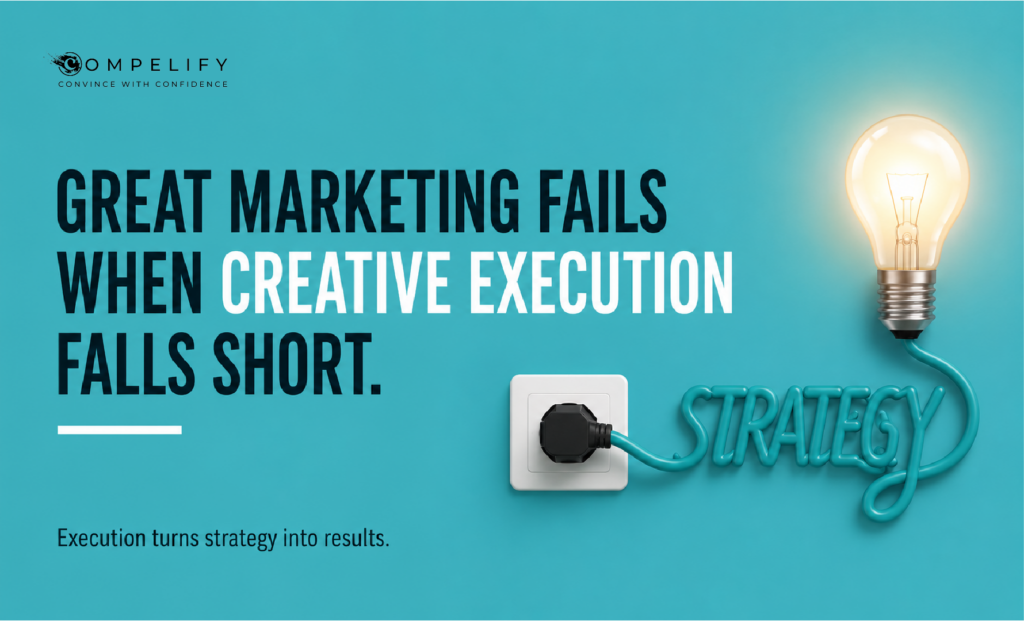
Marketing strategy creates direction. Creative execution determines whether people actually respond.
Strategy Creates Opportunity, But Creative Drives Action
A strong marketing strategy establishes the roadmap for growth. It defines who the business wants to reach, what message needs to be communicated, and how that message should be distributed. Without strategy, campaigns become reactive and inconsistent.
However, strategy alone does not create momentum.
Every campaign eventually reaches a point where the audience must engage with something tangible. It may be an advertisement, a landing page, a sales presentation, a social media campaign, or an email sequence. Regardless of the format, the audience is no longer interacting with the strategy itself. They are interacting with the creative execution built around it.
This distinction matters more than many organizations realize.
Even when strategy is well developed, poor execution can create enough friction to prevent the audience from ever moving toward action.
Audiences Judge Faster Than Businesses Expect
Consumers process information quickly. In most cases, people begin forming opinions within seconds of encountering a brand. Long before they read supporting copy or fully understand the offer being presented, they are already evaluating credibility based on visual and emotional cues.
The audience is subconsciously asking simple questions.
Does this feel trustworthy?
Is this relevant to me?
Do I understand what is being offered?
Does this feel professional?
Creative execution directly influences how these questions are answered.
A poorly designed landing page may immediately create doubt. Inconsistent branding can make a company feel disorganized. Weak visual hierarchy forces users to work harder to understand information. Messaging that lacks clarity increases confusion, which often leads to disengagement.
The strategy itself may be correct. The creative simply failed to communicate it effectively enough to hold attention.
Good Creative Removes Friction From Decision Making
Strong creative work is often misunderstood as purely aesthetic.
In reality, effective creative execution exists to make decisions easier for the audience. Good design guides attention naturally, prioritizes important information, reinforces trust, and creates a clear path toward action. Every visual element should support understanding rather than compete for attention.
This is where many campaigns begin losing performance.
Businesses sometimes focus heavily on campaign strategy while treating creative production as a final deliverable rather than a performance driver. Design becomes something created after strategic decisions have already been made rather than something intentionally built to strengthen those decisions.
High-performing campaigns approach this differently.
They recognize that design is not decoration. It is communication.
When creative execution is built intentionally, audiences spend less time processing confusion and more time moving toward action.
Consistency Strengthens Trust Across Every Touchpoint
Creative execution extends beyond individual campaigns. It influences how audiences perceive the business as a whole.
Most buyers interact with brands through multiple touchpoints before making decisions. Someone may first encounter a company through an advertisement, then visit a website, download a sales deck, browse social media content, and eventually engage with a sales team.
Each interaction contributes to trust.
When these touchpoints feel inconsistent, credibility begins to weaken. Visual inconsistency creates uncertainty, even when the underlying service or product offering remains strong.
Consistent creative execution reinforces confidence.
It tells the audience that the organization understands how it communicates, understands its own positioning, and has invested in creating a clear and cohesive customer experience.
Those signals directly influence conversion.

Great Marketing Requires Great Execution
Marketing performance is rarely determined by strategy alone.
Businesses can invest heavily in audience research, campaign planning, and channel selection, but none of those efforts matter if the creative execution fails to persuade people to act. Strategy creates the opportunity. Creative execution determines whether that opportunity turns into measurable results.
The strongest brands understand this connection early.
Creative should never be treated as the final step of a campaign. It should function as a core part of the strategy itself, designed intentionally to support trust, reduce friction, and compel action.
Because in the end, great marketing does not fail because businesses lack ideas.
It fails when the execution is not strong enough to bring those ideas to life.