We are Your Elite Creative Team To Compel Action

About the author

Octavia Cephalo

Brand Ambassador

Octavia Cephalo

Brand Ambassador

Octavia is a remarkably playful and strategic octopus that brings a unique perspective to our creative team. She expertly navigates the depths of branding, exploring the ocean, and connecting with our audience through lively social media interactions.

Follow Us

Contact Us

Would you like your creative
collateral to be more compelling?

Table of Contents

Good design gets attention.

That simple reality has led many businesses to believe that attractive visuals automatically lead to stronger performance. Teams invest heavily in polished websites, premium branding, social media graphics, advertising creative, and sleek presentation materials with the assumption that better design naturally produces better results.

Unfortunately, that assumption often creates a costly misunderstanding.

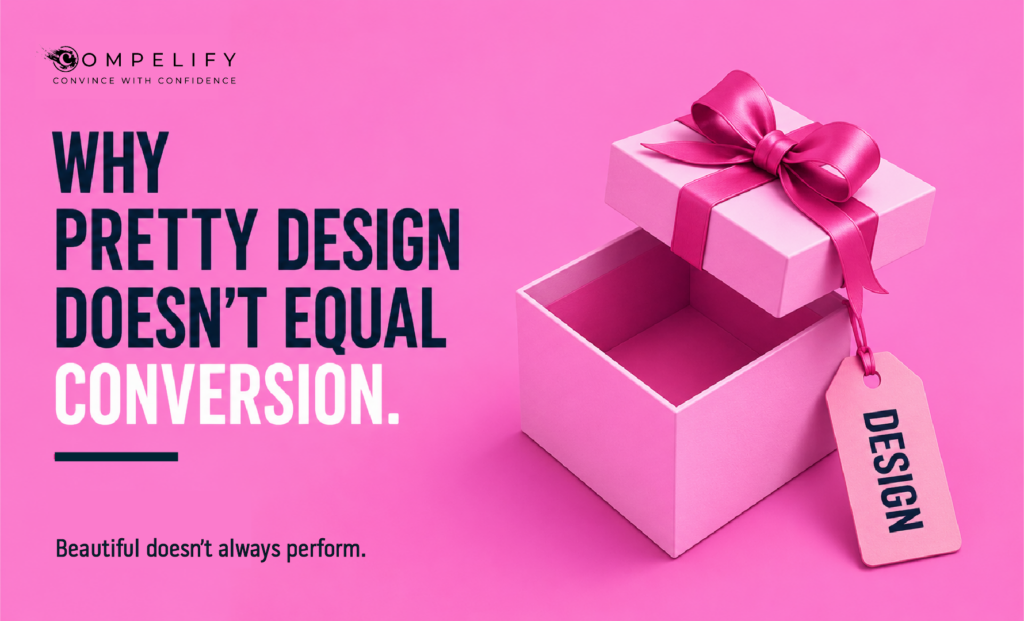
Design can absolutely improve performance, but visual appeal alone does not guarantee conversion. A website may look impressive and still struggle to generate leads. An ad campaign may feel beautifully designed while failing to drive engagement. A sales page may appear modern and polished while quietly losing customers every day.

The problem is simple. Businesses often confuse beautiful design with effective design.

Strong creative should do more than look good. It should guide people toward action.

Visual Appeal Captures Attention, But It Does Not Close Decisions

A well-designed brand immediately creates stronger first impressions. Clean visuals communicate professionalism, reinforce trust, and make businesses feel more credible. In competitive industries, these early impressions can make an enormous difference.

However, attention alone is not the same as conversion.

The purpose of design is not simply to make something attractive. Its real job is to help audiences understand information quickly enough to make decisions confidently.

This distinction matters because many organizations prioritize aesthetics while overlooking function.

A homepage may use beautiful photography, elegant typography, and modern layouts, but if visitors cannot immediately understand what the business offers, the design begins working against performance instead of supporting it.

The design succeeded visually.

It failed strategically.

Conversion Depends On Clarity

Every customer interaction begins with a simple question.

What happens next?

Visitors arriving on a website need immediate clarity. Prospects viewing a landing page need to understand value quickly. Buyers engaging with advertising need enough confidence to continue exploring rather than leaving.

Strong conversion-focused design removes uncertainty.

It helps users process information without friction by establishing clear hierarchy, intentional messaging, and obvious next steps. The audience should never feel forced to search for answers.

This is where many beautifully designed experiences quietly lose performance.

Designers sometimes prioritize aesthetics so heavily that functionality begins to suffer. Navigation becomes overly complex. Calls to action become visually secondary. Messaging loses clarity because layouts prioritize style over communication.

The result is often impressive creative that struggles to perform.

Design Should Support Decision Making

Effective design influences behavior.

Every visual element serves a purpose beyond aesthetics. Typography controls readability. Layout determines how information is processed. Color creates emphasis and emotional response. Spacing guides attention naturally across the page.

These decisions directly affect conversion.

High-performing design does not happen accidentally. It is intentionally structured around how people consume information and how quickly they move toward decision making.

The strongest brands understand that design exists to create movement.

It should direct the audience toward the most important information first. It should simplify decision making rather than adding unnecessary complexity.

This often requires businesses to challenge assumptions.

Something can look beautiful while still performing poorly.

Something can feel visually minimal while dramatically improving conversion.

Performance should always take priority over preference.

Businesses Often Design For Themselves Instead Of Their Audience

One of the most common mistakes businesses make is evaluating design based on internal opinion rather than customer behavior.

Leadership teams review creative and ask questions like:

Does this look modern?

Do we like this color palette?

Should the homepage feel more premium?

Would this animation look impressive?

While these conversations matter, they often miss the bigger question.

Will this help customers take action?

Design decisions should always be evaluated through the lens of user behavior.

The audience does not care whether a design feels trendy.

They care whether they understand the message quickly enough to trust the business and feel confident moving forward.

When design priorities become internally focused, conversion often suffers.

Great Design Compels Action

Design has always been one of the most powerful business tools available.

It builds trust, strengthens perception, reinforces credibility, and shapes how audiences experience a brand. But great design should never be measured purely by appearance.

Its real value comes from performance.

The most effective creative does not simply impress audiences.

It guides them.

Businesses that consistently outperform competitors understand this difference early. They build creative systems designed around clarity, trust, and conversion rather than visual preference alone.

Because beautiful design can attract attention.

But effective design compels action.

And action is what drives growth.